

Popular Games Found at a Filipino Peryahan
Pinoy Peryahan Games are the familiar booth and table games found around local fairs, from Color Game and roleta to shooting booths, bingo and ring toss. Here, the focus is simple: How these games work, where skill enters the picture, and how traditional perya mechanics differ from their digital versions.
Pinoy Peryahan Games at a Traditional Fair
A peryahan rarely feels quiet. Music from the rides spills into the game area, vendors call out from nearby stalls, and small groups gather around whichever table has the liveliest round. Between the Ferris wheel, carousel and food stands, games give the perya its competitive side.
The mix is broader than many people remember. Some Pinoy Peryahan Games are built almost entirely around chance. Others give the person holding the dart, gun or ring some control over the result.
A practical way to separate them is:
- Chance games: Color Game, Drop Ball, roleta and number-based games.
- Skill games: Shooting booths, balloon darts, ring toss and ball-toss challenges.
- Group games: Bingo, where many participants follow the same draw at once.
That difference matters. Someone who enjoys aiming at bottles is getting a completely different experience from someone watching three colored dice tumble onto a table.
Color Game
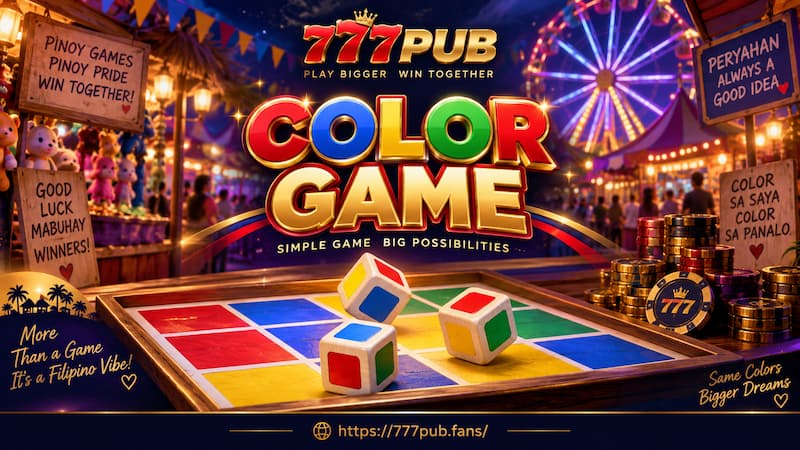
Color Game is one of the easiest peryahan tables to recognize. Instead of learning card rankings or complicated scoring rules, you are looking at colors and waiting for the dice.
Color Game
A documented Filipino perya setup can use six available colors and three wooden dice. Participants choose a color before the dice are rolled, and the colors facing upward determine the result. The National Irrigation Administration used exactly that arrangement for a perya-themed event in 2025.
How a Round Works
The physical sequence is short:
- Pick one of the available colors.
- Place the stake or token on that color.
- The operator rolls three colored dice.
- Check the upper faces when the dice stop.
- Settle the round according to the booth’s payout rules.
That speed is part of Color Game’s appeal in a crowded fair. A person walking past can understand the basic action within seconds. There is no long setup and little downtime between rounds.
Rules can still vary from one operator to another. Number of colors, prize structure and payout calculation should therefore be checked at the actual table rather than assumed from another peryahan.
Chance Controls the Result
Color Game may invite plenty of shouting, guessing and favorite-color rituals, but throwing accuracy has nothing to do with the outcome. Once a choice is made, the dice decide.
That separates it sharply from the shooting booths only a few meters away. In one game, better aim can help. In the other, confidence in red, blue or green does not change how the dice land.
Roleta
Roleta brings a different visual rhythm. The wheel spins, slows down, clicks past several sections and finally stops with the pointer resting on one result.
Traditional peryahan versions do not have to resemble casino roulette beyond the basic wheel concept. A perya wheel may be divided into sections representing candy, snacks, drinks, toys or other prizes. Some versions include a losing section commonly called “bokya.” GMA’s feature on Filipino peryahan games describes this prize-oriented format as a familiar fair attraction.
The simplicity makes it easy to gather a crowd. Everyone can follow the same pointer, and the tension rises naturally as the wheel loses speed.
In a peryahan, “roleta” should not automatically be read as casino roulette. The wheel may look familiar, but the rules, prizes and winning conditions can be completely different.
That distinction prevents a surprisingly common misunderstanding when traditional Pinoy Peryahan Games are discussed online.
Drop Ball
Drop Ball creates suspense without dice or a spinning wheel. The action comes from watching a ball travel through a funnel or dropping mechanism before bouncing toward the final result area.
Players normally choose a position before the ball is released. After that, the path becomes difficult to predict. A tiny change in the bounce can send the ball somewhere completely different.
GMA identifies Drop Ball alongside Color Game, roleta, bingo and projectile games when describing recognizable peryahan attractions.
Color Game and Drop Ball Compared
The two games share quick rounds and visible outcomes, but the physical mechanisms are clearly different.
- Color Game: Three colored dice produce the result.
- Drop Ball: The final resting position of the ball produces the result.
- Both: The player makes the choice before the random physical action takes place.
This is a useful distinction because digital adaptations can make both games look similar on a screen. At a physical perya, the difference is obvious: One table is waiting for dice; the other is following a bouncing ball.
Shooting, Darts and Ring Toss
Not every peryahan booth asks you to predict an outcome. Some hand the result back to you.
Projectile and tossing games have long been part of the fair setup. Targets may be bottles, balloons, pegs or marked areas. The exact booth changes, but the underlying challenge stays familiar: You have a limited number of attempts and need enough accuracy to earn the prize.
Shooting Booths
A shooting booth usually places the participant behind a fixed line with a toy or pellet-style gun aimed toward targets. Bottles and knock-down objects are common examples.
In NIA’s documented perya setup, each participant received five attempts with a toy gun and needed three consecutive target hits to win.
A real commercial perya can use different rules, but this example shows what separates shooting from Color Game: Execution affects the outcome. A steadier hand, cleaner sight picture and better trigger control can make a difference.
Balloon Darts
Balloon darts reduce the idea to its simplest form: Stand behind the line, throw and try to pop the target.
Some booths attach prizes directly to successful hits. Others hide prize information inside or behind individual balloons. The setup can change without changing the core challenge.
The satisfying part is immediate. Either the dart finds the balloon with that sharp pop, or it does not.
Ring Toss
Ring toss looks almost too easy until the first ring bounces off a bottle neck.
The player throws from a marked distance and tries to land the ring around a bottle or peg. NIA’s 2025 perya activity gave participants three rings, with individual bottles corresponding to different prizes.
Skill Versus Chance
Shooting, darts and ring toss belong together because your physical execution matters. Color Game and Drop Ball belong on the other side: Once the initial choice is made, the resolving event is outside your control.
That simple split explains more about Pinoy Peryahan Games than a long list of booth names ever could.
Bingo at the Peryahan
Bingo changes the pace again. Instead of one quick throw or spin, attention stays on a numbered card as the caller announces one number after another.
Participants mark matching numbers and wait for the required pattern to form. Depending on the rules, that can be a horizontal, vertical, diagonal or another announced arrangement.
The caller is often half the entertainment. Filipino bingo sessions are known for playful number calls, jokes and wordplay that keep the room or booth lively even when a card has gone painfully cold. GMA notes this social calling style as part of the traditional peryahan bingo experience.
Bingo therefore feels less solitary than many booth games. Everyone is watching different cards, but the entire group reacts to the same number.
Coin Toss and Smaller Booth Challenges
Some of the most recognizable perya games need almost no machinery.
A coin toss can consist of nothing more than a marked surface and a few coins. One documented setup gave each participant four ₱0.25 coins and awarded a prize when a tossed coin landed completely within a marked square.
Ball toss follows the same stripped-down logic. Throw an object toward a defined target and satisfy the booth’s condition within a limited number of tries.
Operators can alter the distance, target size, number of attempts and prize structure, which is why it makes little sense to describe one rule set as universal. The recognizable part is the challenge itself.
Pinoy Peryahan Games in Digital Form
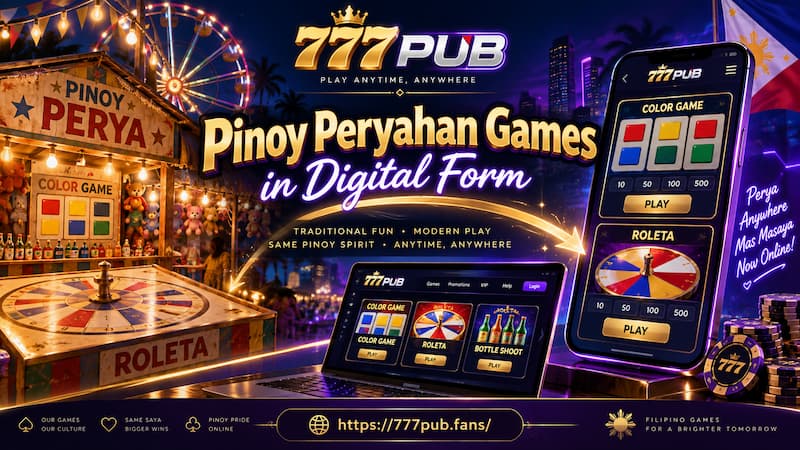
Moving from a physical fair to an online casino changes the presentation more than the basic idea. Dice can become animated results. A physical betting board becomes selectable areas on a screen. Number draws and color predictions can be resolved without a bangka standing beside the table.
Pinoy Peryahan Games in Digital Form
For anyone comparing those two environments, 777PUB provides an online casino context where familiar Filipino gaming terminology can meet modern digital formats. The useful comparison is not whether a screen perfectly recreates the perya. It does not. The interesting part is which mechanics survive the transition.
Color Game is a good example. The traditional version gets much of its character from three physical dice, people crowding around the board and the operator running each round. Digital versions can preserve color selection and random resolution while removing the wooden dice, booth noise and face-to-face interaction. That also separates these games from a live casino, where a real dealer or host remains part of the presentation.
That makes them related formats rather than identical experiences.
The Character of a Filipino Peryahan
Pinoy Peryahan Games work because most of them reveal themselves quickly. Watch one round of Color Game, one spin of roleta or one person trying to hook a ring around a bottle, and the objective becomes obvious.
The strongest perya mix also avoids relying on only one type of game. Chance sits beside skill. A noisy Color Game table can operate near a quiet moment of concentration at the shooting booth, while a bingo caller keeps another crowd occupied for much longer.
That variety is the real shape of the peryahan. Color Game, Drop Ball, roleta, bingo, shooting, darts and ring toss may use very different mechanics, yet each fits the same lively fairground setting. Whether remembered from a fiesta or encountered through a newer digital version, their identities come from the way each game is played—not simply from bright colors, prizes or carnival decoration.