

What a Medium RTP Means for Slot Players
Medium RTP Slots sit near the middle of the usual online slot return range. Understanding that percentage makes it easier to compare games, estimate long-run cost in PHP, separate RTP from volatility and check the exact game value available at Phdream before choosing where to play.
Medium RTP Slots and the Typical RTP Range
RTP, or Return to Player, represents the theoretical percentage of wagered money a slot returns over a very large number of spins. A game with a 96% RTP is mathematically designed to return about ₱96 for every ₱100 wagered across its full statistical lifespan, while the remaining 4% represents the theoretical house edge.
For practical comparison, Medium RTP Slots can be treated as games sitting roughly between 95.00% and 96.99%. That range is useful because many modern online slots cluster close to 96%.
It is not an official industry classification, however. There is no universal rule declaring that 95.5% must be “medium” while 97% must be “high.” Different databases, game reviewers and casino libraries may use slightly different boundaries.
The exact number matters more than the label.
A slot running at 95.05% and another running at 96.85% might both fall into a medium-RTP category, yet the mathematical difference between them becomes noticeable once betting volume grows.
Reading a 96% RTP Correctly
The most common mistake is treating RTP as a prediction for one playing session.
If you deposit ₱1,000 into Phdream and choose a 96% RTP slot, it does not mean you should expect to finish with ₱960. Your balance might rise, fall quickly or move back and forth for hundreds of spins.
RTP applies to total betting turnover over a huge sample.
Suppose you repeatedly wager the same balance and eventually accumulate ₱10,000 in total bets. A theoretical 96% return corresponds to ₱9,600 returned through winning spins over the long run.
That is very different from saying a ₱10,000 deposit becomes ₱9,600.
RTP describes long-term game mathematics. It does not promise a particular result after 20, 200 or even several thousand spins.
RTP and House Edge
RTP and house edge are two sides of the same calculation:
- 95.00% RTP = 5.00% theoretical house edge
- 96.00% RTP = 4.00% theoretical house edge
- 96.50% RTP = 3.50% theoretical house edge
- 96.90% RTP = 3.10% theoretical house edge
A higher RTP therefore reduces the theoretical cost of wagering, although short-term results can still vary dramatically.
Medium RTP in PHP Betting Volume
Percentages become much easier to understand when converted into actual wagering amounts.
Imagine three Medium RTP Slots receiving ₱10,000 in cumulative bets.
- 95.00% RTP: Theoretical return is ₱9,500, leaving a ₱500 mathematical difference.
- 96.00% RTP: Theoretical return is ₱9,600, leaving ₱400.
- 96.50% RTP: Theoretical return is ₱9,650, leaving ₱350.
None of those figures predicts what one player will actually cash out. They simply show the expected mathematical relationship after enough betting activity for actual results to move closer to the designed RTP.
Small RTP Differences Become Larger Over Time
A difference of 1.5 percentage points can look insignificant on a game screen. Across repeated betting, it is not.
Compare 95.00% with 96.50%:
- ₱10,000 wagered: ₱150 theoretical difference
- ₱50,000 wagered: ₱750 theoretical difference
- ₱100,000 wagered: ₱1,500 theoretical difference
This is one reason I would never compare Medium RTP Slots only by theme, graphics or bonus-round design. When two games are otherwise equally appealing, the exact RTP provides a useful mathematical tie-breaker.
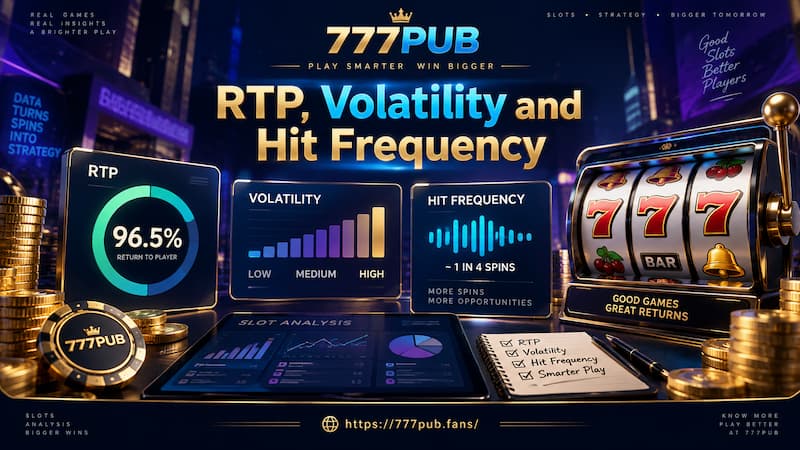
RTP, Volatility and Hit Frequency
A slot can have an attractive RTP and still feel completely wrong for the way you prefer to play.
That happens because RTP tells you how much money is theoretically returned, but not how that money is distributed.
RTP, Volatility and Hit Frequency
Medium RTP Does Not Mean Medium Volatility
Volatility describes the spread of possible results.
A lower-volatility game generally produces smaller wins more regularly. High-volatility slots tend to concentrate more of their return in less frequent but potentially larger outcomes.
Two games can both operate at 96% RTP and behave very differently.
Same RTP, Different Playing Pattern
Consider two hypothetical slots:
Slot A:
- RTP: 96%
- Low volatility
- Frequent smaller payouts
- Balance may move more gradually
Slot B:
- RTP: 96%
- High volatility
- Longer gaps between meaningful wins
- More return concentrated in larger payouts
Their long-run theoretical return is identical. Their short-term experience is not.
For someone using smaller bets and wanting a longer session, Slot A may feel easier to manage. A player specifically interested in larger bonus-round potential may prefer Slot B despite the sharper swings.
Neither preference changes the RTP.
Hit Frequency Is a Separate Number
Hit frequency adds another layer. It normally represents how often a spin produces a defined winning result.
A 30% hit frequency does not mean the game returns 30% of wagers, and it does not automatically make the slot better than one with a 20% hit rate.
One game might produce many tiny payouts. Another could pay less frequently while allocating more of its theoretical return to larger combinations or bonus features.
RTP, volatility and hit frequency should therefore be read together rather than treated as interchangeable statistics.
Comparing Medium RTP Slots Properly
Once you understand the percentage, comparing games becomes much more precise.
At Phdream, I would start with the exact RTP rather than simply looking for a game described as medium RTP. After that, volatility, paylines and paytable structure become more important than another tenth of a percentage point.
A useful comparison includes:
- Exact RTP percentage
- Volatility level
- Hit frequency when disclosed
- Minimum and maximum bet
- Maximum win or payout cap
- Free-spin and bonus mechanics
- How much of the RTP depends on special features
The same process is useful when comparing games across other casino libraries such as 777PUB, because identical-looking slot titles do not always tell you everything about the mathematical configuration being offered.
Check the Exact RTP, Not Just the Category
Consider a 95.10% slot beside a 96.80% slot.
Both can reasonably be called Medium RTP Slots. Yet there is a 1.70-percentage-point difference between them.
Across ₱100,000 in theoretical turnover, that gap represents ₱1,700 in expected return.
That does not mean the 96.80% game will produce a better result tonight. It means its underlying long-run mathematical cost is lower.
RTP Variants of the Same Slot
This point is easy to miss.
Some developers release the same game with several approved RTP configurations. One casino may run a slot at 96.2%, while another version of the same title could operate at 94%, 95% or another percentage.
The artwork may be identical. The reels may look identical. The bonus round may even behave the same way.
The mathematics underneath can still differ.
Provider Average vs Game RTP
A provider being known for slots near 96% does not mean every title from that studio runs at exactly 96%.
Provider averages are useful for broad research. They should never replace checking the individual game’s information screen.
Checking Medium RTP Slots at Phdream
Before placing a meaningful bet, open the slot’s game information, rules or paytable. The exact wording varies by developer, but RTP is often shown alongside game rules or technical information.
I would check the details in this order:
- Confirm the RTP.
- Find the volatility level if available.
- Check the minimum bet in PHP.
- Read how bonus features are triggered.
- Note the maximum payout.
- Compare the game with at least one similar alternative.
This takes only a minute and prevents a common mistake: Choosing a familiar title without checking which version is actually available.
Build a Small Shortlist
There is little value in comparing 40 games at once.
Choose three or four slots that genuinely interest you, then compare their RTP, volatility, betting range and feature structure side by side.
A 96.1% medium-volatility game may be a better personal fit than a 96.6% high-volatility game if you dislike long stretches without significant payouts. The higher RTP is mathematically preferable, but it does not automatically create the more comfortable betting pattern. RTP should also sit within a broader responsible gaming approach, since a better theoretical return does not remove the need to control bet size, budget and session length.
When Medium RTP Is a Useful Filter
Medium RTP works best as a filtering tool rather than a final verdict.
It helps narrow a large slot library by removing titles with unusually low theoretical returns while still leaving plenty of choice across themes, providers and volatility levels.
A medium-RTP range can make sense when:
- You want a practical minimum RTP standard.
- Several similar games are competing for your attention.
- You prefer comparing mathematics before graphics or themes.
- You are willing to consider volatility alongside RTP.
There are also situations where I would keep looking. If two very similar games are available and one offers 95.1% while another offers 96.7%, the higher-return version deserves serious consideration. Likewise, if the exact RTP cannot be found, comparing the game confidently becomes harder.
Using RTP as a Decision Tool
Medium RTP Slots are not automatically good or bad. “Medium” is simply a convenient way to organize a broad group of games.

Using RTP as a Decision Tool
The useful information lies underneath that label: The exact RTP reveals theoretical long-run return, volatility shows how unevenly payouts may arrive and bet size determines how quickly those swings affect a PHP balance.
For a practical comparison at Phdream, keep the order simple:
Exact RTP → volatility → bet size → game mechanics → personal preference.
That sequence turns RTP from a percentage buried in a paytable into something genuinely useful when deciding which slot deserves your time.